
Ontario Winters Don't Get Easier. They Just Get More Expensive.
The shoveling is the part everyone sees. The ice you can't spot until someone slips, the salt grinding into your concrete all winter, the quiet dread every time the forecast drops below zero — that's the rest of it. You're spending real money every season and still waking up to the same problem in the dark.
The 5 AM Alarm You Already Dread
It's 5:10 AM. Sixteen centimetres overnight. You pull on your coat before you're fully awake, step outside into minus fourteen, and your lower back tightens before the shovel even bites the snow. Forty minutes later you're sweating through your jacket, late, and the plow just buried the end of the driveway again. This is 15 to 20 mornings a winter. Every winter. For as long as you own this house.
Ice That Looks Like Wet Pavement
Black ice forms overnight when the temperature swings near zero. It's invisible until someone's foot goes sideways. Your mother walking to her car. Your kid sprinting out the door at 7:45. A delivery driver who slips and calls a lawyer. Salt helps at minus five. At minus fifteen it just sits there. The worry doesn't go away — it just moves to the back of your mind, where it stays all winter.
Paying Every Year for the Same Problem
Snow removal contracts in Ontario run $800–$1,700 a season. That's before the bags of salt, and before the concrete repairs when that salt works its way into the surface — spalling along the edges, hairline cracks that open up in the freeze-thaw cycle, resurfacing every few years. Every April you see the damage. You're spending money, season after season, on a system that slowly eats the driveway you're trying to protect.
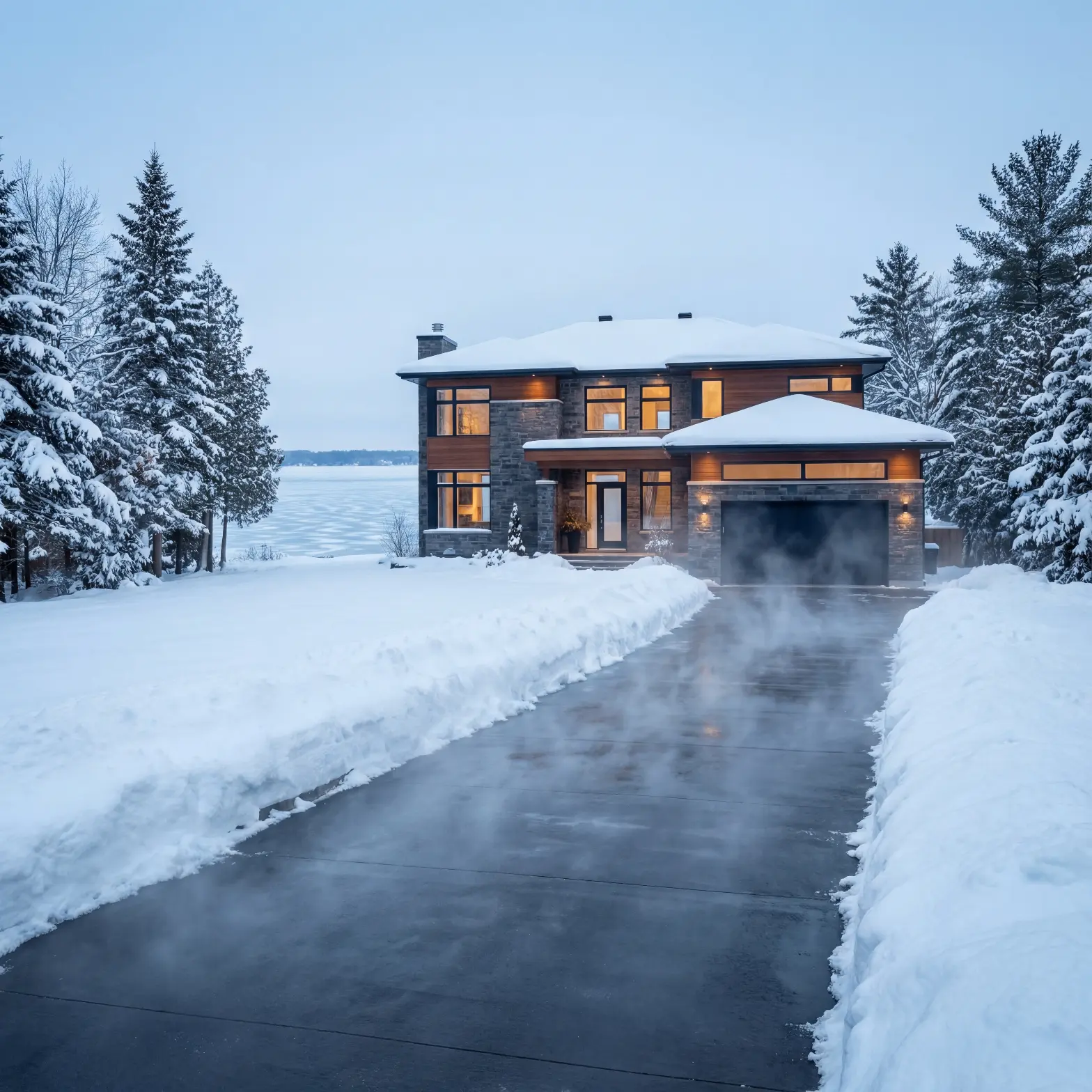
System Active
Melting snow automatically
-20°C
Outside Temp
+3°C
Surface Temp
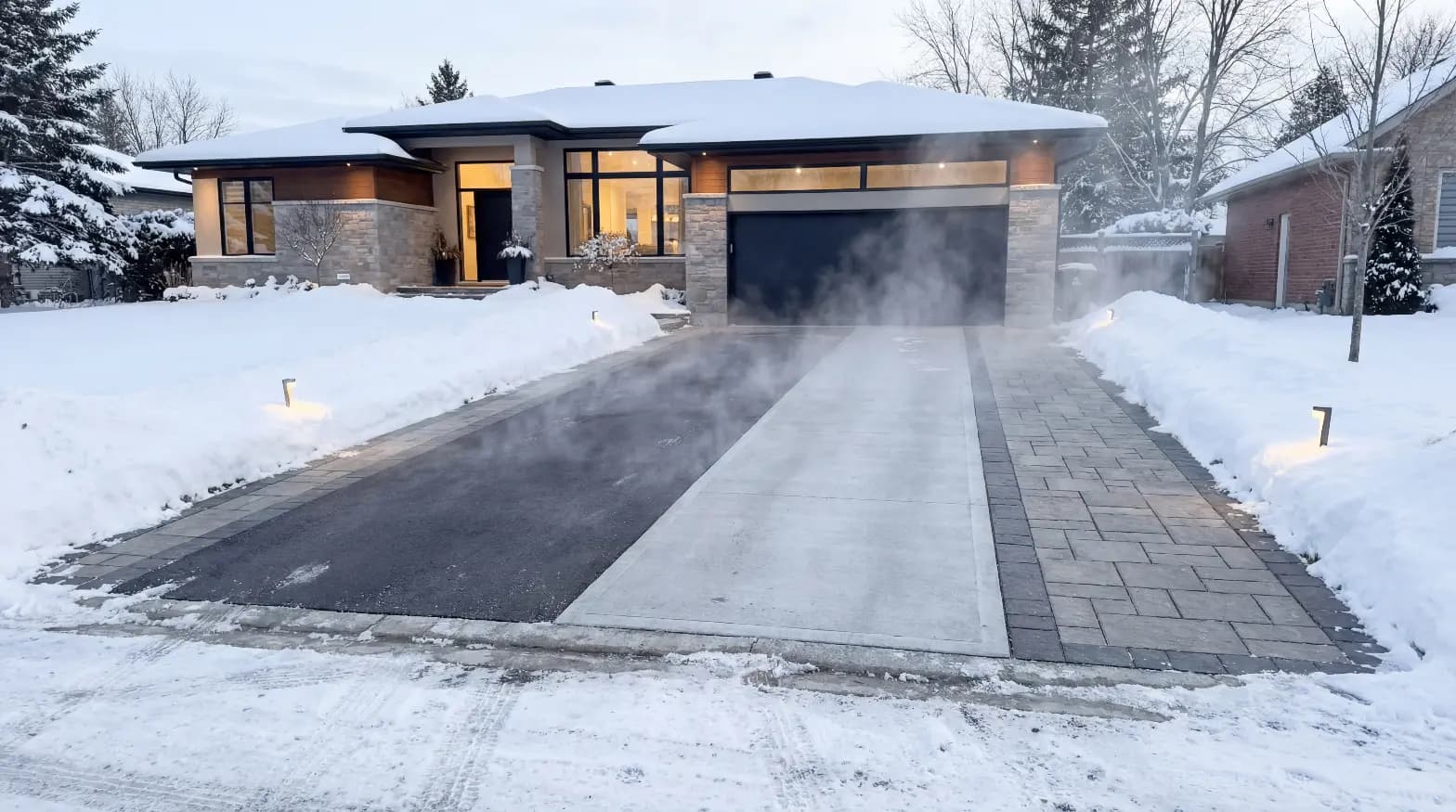
Cables Set in Concrete
Installed before the pour
What's Actually Happening Under Your Driveway
Before the concrete is poured, we lay heating elements across the prepared base. Electric systems use resistance cables — the same principle as a heated floor, scaled up. Hydronic systems use flexible tubing that circulates hot water from a boiler, similar to radiant floor heating. A sensor mounted near the surface watches two things: temperature and moisture. The moment it detects precipitation and the surface drops below a threshold you choose, the system turns on. Concrete warms from below. Snow melts as it lands, before it ever packs down or turns to ice.
Electric systems cost less upfront and suit most Ontario properties. Hydronic runs more efficiently in sustained extreme cold, but the boiler adds installation cost and one annual service call. Neither is right for every situation. We'll tell you which one fits yours — or whether neither does.
- Sensors trigger automatically — the system is running before you wake up
- Operates only when it's cold and wet, not continuously all winter
- Works under concrete, asphalt, or interlocking stone
- Electric systems need no routine maintenance — just a sensor check every few years
- Hydronic systems require one annual boiler service, the same as your home heating
What Changes When Your Driveway Heats Itself
A heated driveway won't fix a tight budget, and it won't make sense for every property. Small driveway, mild winters, a snow removal contract that already works — those are real reasons to skip it, and we'll say so. But if you're dealing with genuine Ontario winters, the kind that run November through March with 40-plus snowfall events, here's what actually shifts.
30 Minutes Back Every Snowy Morning
Your alarm goes off at 6:20. You look out the window. The driveway is already dry — the sensor caught the temperature drop at 3 AM and the system handled it while you slept. No coat, no shovel, no scraping ice off the windshield while your coffee goes cold. Ontario gets roughly 40 snowfall events a season. That's 40 mornings you don't spend in the dark, hunched over a shovel.
A Surface That Stays Above Freezing
Black ice forms overnight when the temperature swings near zero. It looks exactly like wet pavement — you won't know it's there until someone's foot goes sideways. Your mother walking to her car. Your kid sprinting out the door at 7:45. A delivery driver who slips and calls a lawyer. A heated driveway keeps the surface above freezing. No patches, no slick spots, no guessing whether the salt worked.
Honest Math on the Upfront Cost
A heated driveway is a serious upfront investment, and we won't pretend otherwise. Snow removal contracts in Ontario run $800–$1,700 a season — before salt, before concrete repairs from salt damage. Over 10 to 15 years, the gap narrows considerably. It's still a significant cost, and it's not right for every property. But if you're doing the math, it makes sense to look at the full picture.
No Salt. No Stains. No April Damage.
Salt lowers the freezing point of water. It also works on your concrete, your car's undercarriage, and the grass along your driveway edges. Every spring you see the evidence: white residue, cracked edges, dead strips of lawn. A heated driveway uses no chemicals at all. The surface stays clean. Your concrete looks the same in year twelve as it did in year one — no spalling, no freeze-thaw cracking along the edges.
A Feature Buyers Actually Notice
In Ontario, a heated driveway is still uncommon enough to stand out. Buyers notice it. It signals the property was looked after, and it means one less thing they'll deal with every winter. A dry driveway in January says something about a house that listing photos can't capture. If you're building new, installing now costs a fraction of what a retrofit costs after the concrete is already down.
We Tell You Which System Fits — or Whether Neither Does
Electric systems cost less to install and need almost no maintenance — they handle most Ontario winters without issue. Hydronic systems have a higher upfront cost and circulate hot water through tubing from a boiler — more efficient in sustained extreme cold, but they add installation complexity and one annual service call. We've installed both across Ontario for 10+ years. Sometimes a snow removal contract is still the smarter call, and we'll say that too.
What Actually Goes Into a System That Lasts
The cable or tubing is the part everyone asks about. It's also the part that almost never fails. What separates a system that's still working in year 25 from one that cracks in year 6 is everything around it — the base prep, the concrete depth, the sensor placement, the controller logic. The heating element is maybe 20% of the story. Here's the other 80%.
Two Sensors, Not One
Rain at 4°C and snow at -2°C feel identical to a single thermostat. We install a dual-sensor setup: one probe in the air reading ambient temperature, one embedded in the pavement reading both surface temperature and moisture simultaneously. The system only fires when snow is falling on a cold surface. Not during a warm rain. Not when January sun heats the concrete on a clear afternoon. That logic alone can cut operating costs by 30–40% compared to a timer-based or single-sensor setup.
Variable Output, Not Full Blast
A light dusting at -4°C needs roughly 25–30% of the system's capacity. A February blizzard at -20°C needs all of it. The controller reads conditions continuously and adjusts output in real time. You're not paying to push full heat into a dry slab at 3 AM because the thermostat missed that the storm ended hours ago. The difference shows up on your hydro bill every month of the heating season.
The Concrete Is the System
The heating element is the part everyone asks about. It's also the part that almost never fails. What fails after 10 years is the base. We excavate to proper depth, compact the sub-base, and pour 4-inch reinforced concrete as standard. Heavy vehicle use — trucks, RVs, repeated plowing — gets 5-inch. Ontario's freeze-thaw cycles will crack a slab poured over a soft or poorly graded base. The cable buried inside it won't matter much after that. We've seen what shortcuts look like. We don't take them.
Smart Controls, If You Want Them
Smart controls are available as an upgrade. They let you see whether the system is running, how much energy it's drawing, and adjust setpoints from your phone. You can also review run history — useful if you're trying to understand your operating costs after the first winter. Most homeowners check it once after the first snowfall, then forget it exists. That's the goal. The system does its job. You do yours.
Electric Systems
Resistance cables — a long, controlled heating element — are embedded in the concrete slab and wired to your electrical panel. No boiler, no glycol (antifreeze fluid), no annual service contract. The system draws power when the sensors call for heat and shuts off when the surface is clear. Simpler to install, lower upfront cost. The honest trade-off: operating costs climb noticeably when temperatures drop below -15°C and stay there for days at a time. If you're in Barrie or the GTA, that's manageable. If you're in Ottawa or north of Huntsville, it's worth thinking through.
- Lower upfront cost compared to hydronic. Exact cost depends on driveway size and panel capacity.
- Zero maintenance required. No moving parts, no fluid to check.
- Best fit: areas under 1,200 sq ft, walkways, steps, single-car pads.
- Operating costs rise in deep cold. We'll model this for your climate before you decide.
Hydronic Systems
A glycol-water mix circulates through PEX tubing (cross-linked polyethylene) buried in the slab. A boiler heats the fluid and pumps it through the loops continuously. More infrastructure upfront — boiler installation, annual servicing, more complex pipework — but the operating cost per square foot drops considerably once you're heating large areas through a sustained Ontario winter. The boiler is the one component that needs annual attention. Budget for it.
- Higher upfront cost than electric. Annual boiler service is required.
- Lower operating cost for areas over 1,200 sq ft in deep cold.
- One boiler can serve the driveway, patio, and front steps together.
- Best fit: large driveways, Ottawa-area climates, new construction.
| Comparison | Electric System | Hydronic System | Traditional Removal |
|---|---|---|---|
| Upfront Cost | Lower upfront cost | Higher upfront cost | $800–$1,700/season contract |
| Operating Cost | Rises noticeably below -15°C | More efficient in sustained cold | Your time, your back, your salt |
| Maintenance | None. Zero moving parts. | Annual boiler service needed | Equipment upkeep + blade wear |
| Best Area Size | Under 1,200 sq ft | Over 1,200 sq ft | Any size (you do the work) |
| Cold Weather Performance | Costs climb below -15°C | Holds efficiency in deep cold | Works — if you go outside |
| Surface Damage | None — no salt, no blades | None — no salt, no blades | Salt eats concrete over time |
| Install Complexity | 3–5 days, panel upgrade may apply | Boiler + plumbing adds time | No install — just show up |
What Actually Happens, Start to Finish
Installing a heated driveway is a real construction project. Heavy equipment, excavation, concrete work, a 28-day cure before the system can run. Your driveway will be unusable for 3–5 days. There will be noise and disruption. We're not going to soften that. What we can tell you is that every step has a reason — and that the decisions made during construction are what determine whether the system is still working in year 20.
1. We Come to You First
We don't quote from photos or square footage estimates. A site visit takes about 30 minutes — we measure the area, check your electrical panel capacity, look at the grade and drainage, and ask how you actually use the space. Some properties have drainage problems that would make a heated system perform poorly. Some electrical panels need upgrading before we can even start. We'll tell you all of this before you spend a dollar. If your property isn't a good candidate, we'll say so plainly.
2. Three to Five Days of Real Construction
Your driveway will be a construction zone. Excavation equipment, concrete trucks, a crew on site — and a surface you can't drive on for the duration. We remove your existing driveway, compact the sub-base, lay the heating cables or PEX tubing in precise runs, and photograph every single one before the concrete goes in. Those photographs become your permanent as-built record. If anything ever needs attention in year 15, you'll know exactly where to look. Most contractors skip this step. We don't.
3. Twenty-Eight Days, Then Winter
Concrete needs 28 days to reach full strength. We calibrate the sensors and controller during that curing window and run a full system test before we leave your property. By the time the first real snowfall arrives, everything has already been verified. The pavement sensor reads the surface. The air sensor reads the sky. The controller decides. You wake up to a dry driveway and don't think about it again.
Ontario Winters Are Not All the Same
We're based in Barrie, which means Georgian Bay lake-effect snow is our baseline — the kind that drops 40 cm overnight and buries your car before 6 AM. That's a high-volume, moderate-cold problem. Ottawa is different: the Rideau Canal freezes solid, January temperatures stay below -20°C for weeks at a stretch, and the system has to hold efficiency in sustained deep cold. That changes the system sizing conversation and usually points toward hydronic. The GTA and Mississauga are a third problem entirely — urban driveways are tight, drainage is complicated, and the freeze-thaw cycle (above zero one day, -10°C the next) cracks concrete faster than anywhere else in the province. Muskoka and Georgian Bay cottage properties sit empty for months, which means the system needs to handle long idle periods without supervision. We've worked in all of these climates. The installation standard doesn't change. The system design does.
Not on this list?
We travel for larger projects. If you're somewhere in Ontario not listed here, reach out and describe your property. We'll tell you directly whether the trip makes sense — and exactly what the travel cost would add to your quote. No surprises.

Three Things That Actually Matter
SunFlow is a division of SunFlow Solar & Exteriors. We've been working on Ontario homes for over 10 years. We've turned down jobs. We've told homeowners their property wasn't right for a heated system — drainage problems, panel limitations, a driveway that would need too much remediation to be worth it. We've given quotes that were higher than a competitor's and explained exactly why. We'd rather lose the sale than install the wrong system and have you call us in year three wondering what went wrong.
The Quote Is the Price
Fixed-scope quotes, full stop. The number on your quote is the number on your invoice. We've walked away from jobs where the scope was too uncertain to quote honestly. We'd rather lose the work than quote low, start the job, and come back to you with a change order. That's not how we operate.
We Document as We Build
Before the concrete is poured, we photograph every run of cable or tubing — the full layout, clearly documented. You get a copy. It becomes your permanent record of exactly where the heating elements are buried. If anything ever needs attention in year 15 or year 25, you'll know exactly where to look. Most contractors skip this. We do it on every job.
Product-Dependent Warranty Coverage
Warranty terms depend on the products and controls selected for your project. Coverage typically ranges from 5 to 20 years across workmanship and manufacturer-backed components. We document the exact terms in writing before you sign.
Beyond the Driveway
A clear driveway with icy front steps is still a liability. We install radiant heating for driveways, walkways, steps, and patios. Not every surface makes sense for every property — we'll tell you which ones do, and which ones probably don't.
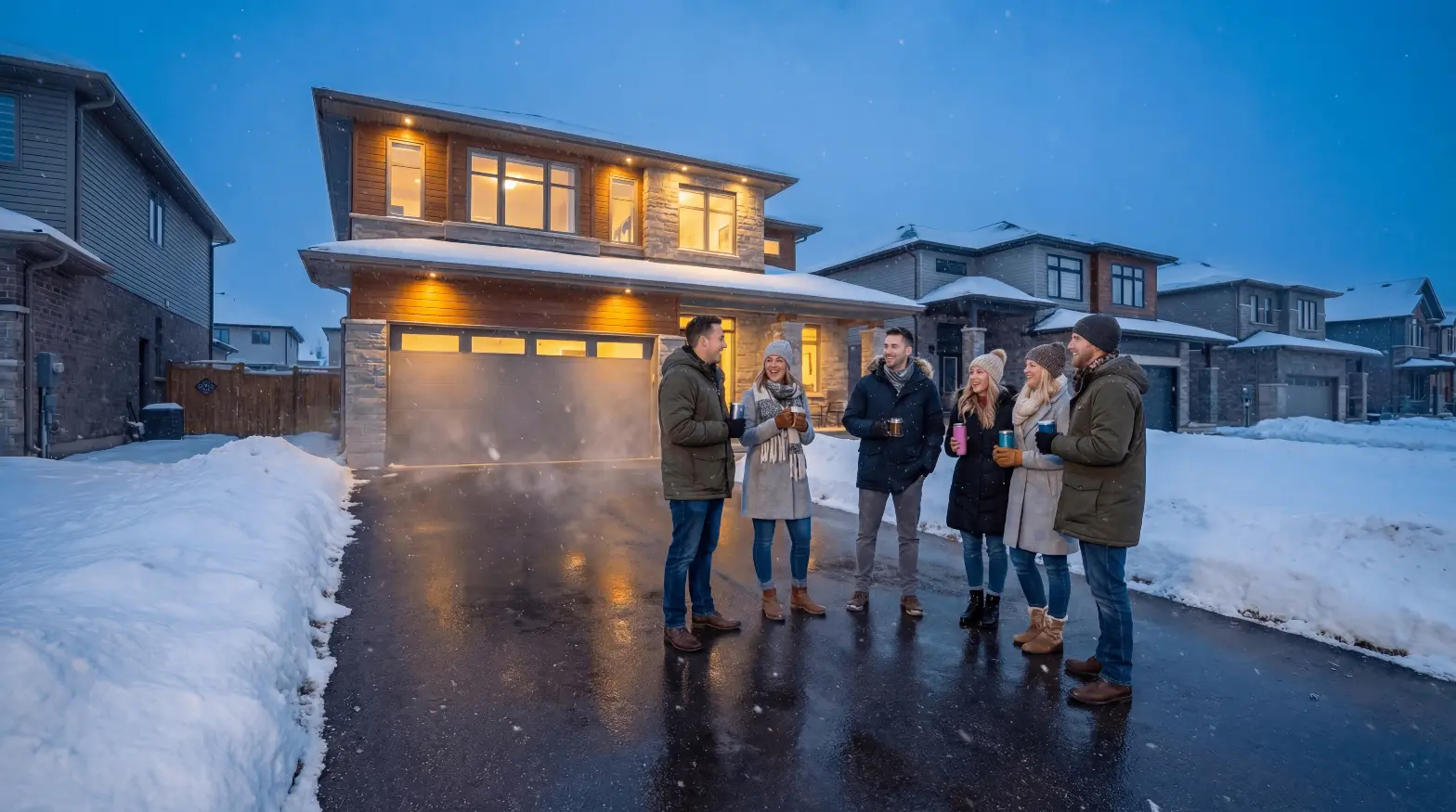
Heated Driveways
The core of what we do. Electric or hydronic, single-car or triple-wide, new construction or full replacement. The system activates automatically when the sensors detect snow falling on a cold surface and shuts off when the surface is clear and dry. Not every property is a good candidate — drainage problems, panel limitations, or a driveway that needs too much remediation can change the math. We'll tell you honestly if yours isn't worth it.
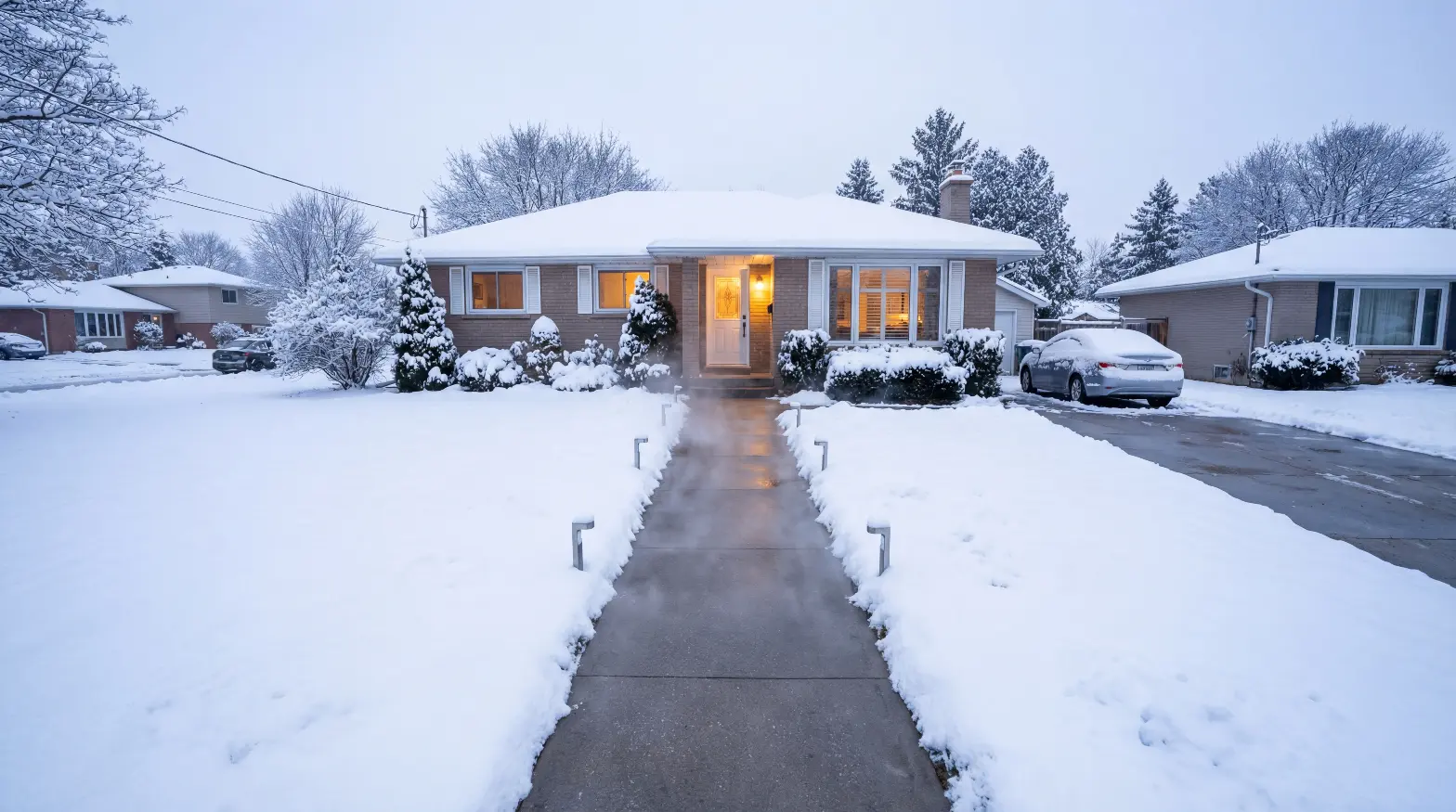
Heated Walkways
Walkways are often more dangerous than driveways. The narrow path to your front door is shaded, it refreezes faster than open pavement, and nobody thinks to salt it at 6 AM before work. Most slip-and-fall injuries happen on exactly this surface. A heated walkway is usually a smaller job than a driveway — and it's worth doing right rather than adding it as an afterthought.
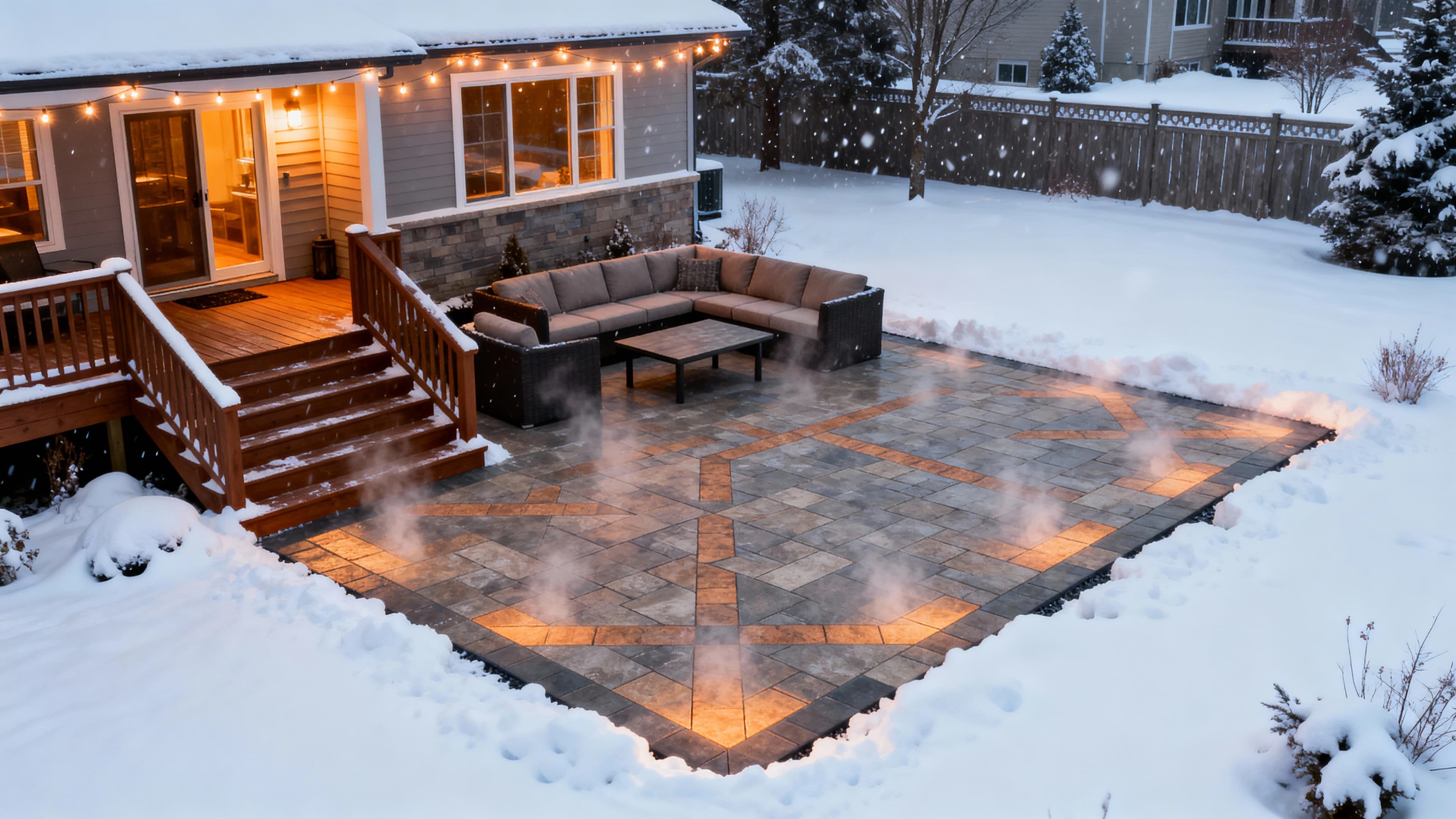
Heated Patios
Not every property needs a heated patio, and we'll say so if yours doesn't. If you have a walk-out basement or an outdoor entertaining space you actually use in October and April, radiant heating can extend the usable season by a few weeks on each end and prevent ice buildup on the surface. If the space sits empty from November to March, the investment probably doesn't make sense.
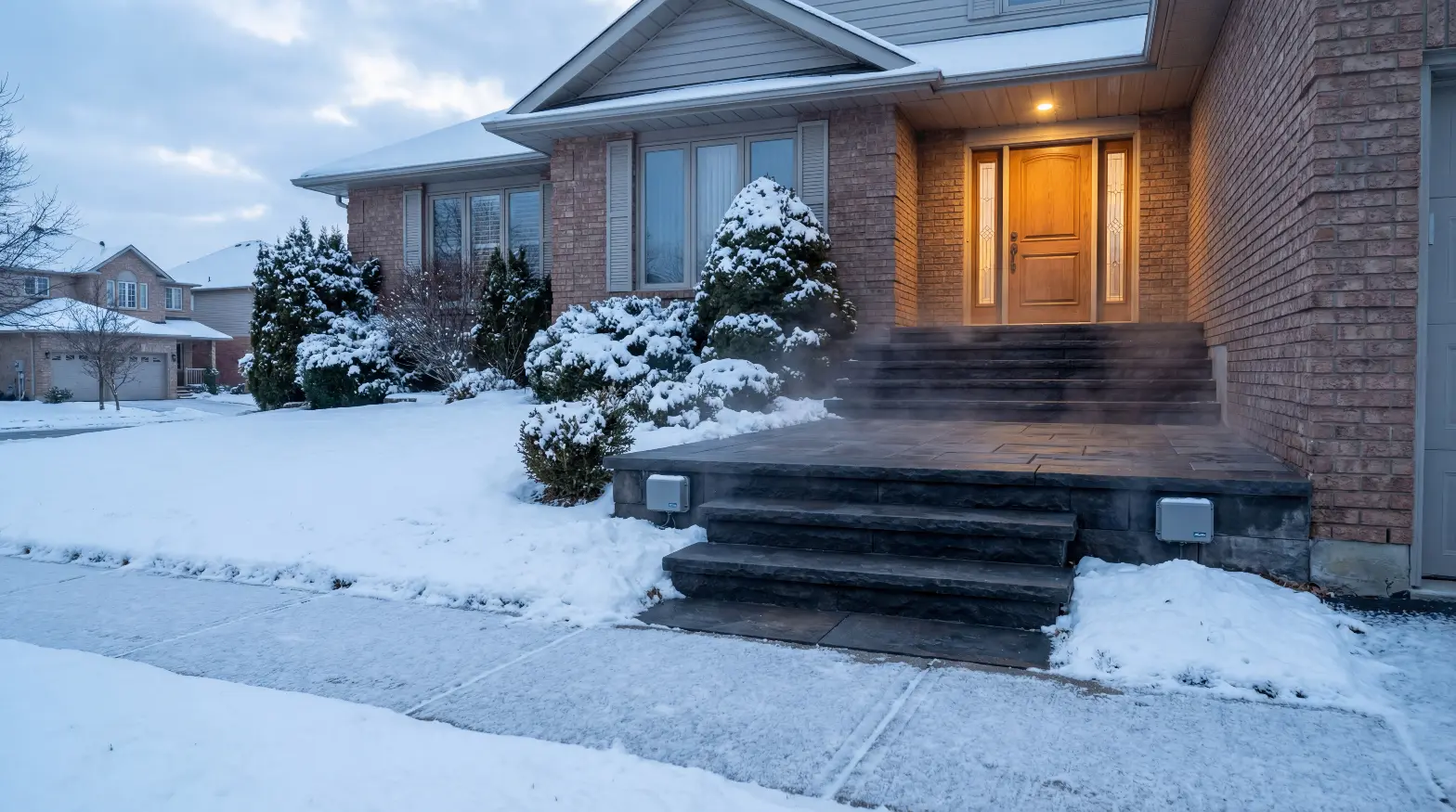
Heated Steps & Porches
Steps are the highest-risk surface on any property. They're narrow, they collect water at the edge, and a fall on concrete steps is serious. Salt damages masonry over time — you can see it in the spalling and pitting on older front stoops across Ontario. Heating eliminates both problems. When we're already doing a driveway, adding the front steps is usually a modest incremental cost. We'll tell you the number before you decide.
The Questions Homeowners Actually Ask
Straight answers. Real numbers. If yours isn't here, see all questions.
The cost depends on system type, driveway size, and whether you're doing new construction or replacing an existing surface. Electric systems cost less to install than hydronic. Hydronic systems have a higher upfront cost but lower operating costs in extreme cold. If your electrical panel needs upgrading to handle the load, that adds to the total — we'll tell you upfront. We give fixed-scope quotes, so the number on your quote is the number on your invoice.
Plan for 3–5 days of active construction. Your driveway will be unusable during that time — no parking, no access. We excavate the existing surface, compact the sub-base, lay the heating elements, and pour new concrete. Then concrete needs 28 days to reach full strength. We calibrate the sensors and run a full system test during that curing window. By the time your first real snowfall arrives, the system has already been verified.
Yes, but the honest answer depends on which system you have. Electric systems work at any temperature, but operating costs climb noticeably when temperatures stay below -15°C for days at a time. If you're in Ottawa or north of Barrie, that's a real consideration. Hydronic systems are more efficient in sustained deep cold and better suited for those climates. We'll tell you which system makes sense for your location and your driveway size before you commit to anything.
No. The heating elements have to be embedded in the concrete slab, which means we excavate your existing surface and pour new concrete. There's no way around this. Anyone who tells you they can retrofit a system without replacing the slab is cutting corners — the elements need to sit 2–3 inches below the surface, in direct contact with the concrete mass that holds and radiates the heat. Skipping the excavation means the system won't perform, and it won't last.
Tell Us About Your Property
Every property is different. Some are straightforward. Some have drainage issues, panel limitations, or a driveway grade that changes the whole conversation. We visit, we measure, we check your electrical panel capacity, and we look at how the water moves across your property. Then we give you a straight answer — what system makes sense, what it costs, and whether it makes sense at all. No cost. No commitment.
What to expect from us
- A site visit first — we measure, photograph, and check your panel before quoting anything
- A fixed-scope quote — the number we give you is the number on your invoice
- A straight answer if your property isn't a good fit for a heated system
Ready to get started?
Share a few details about your property to get a personalized recommendation and estimate.